
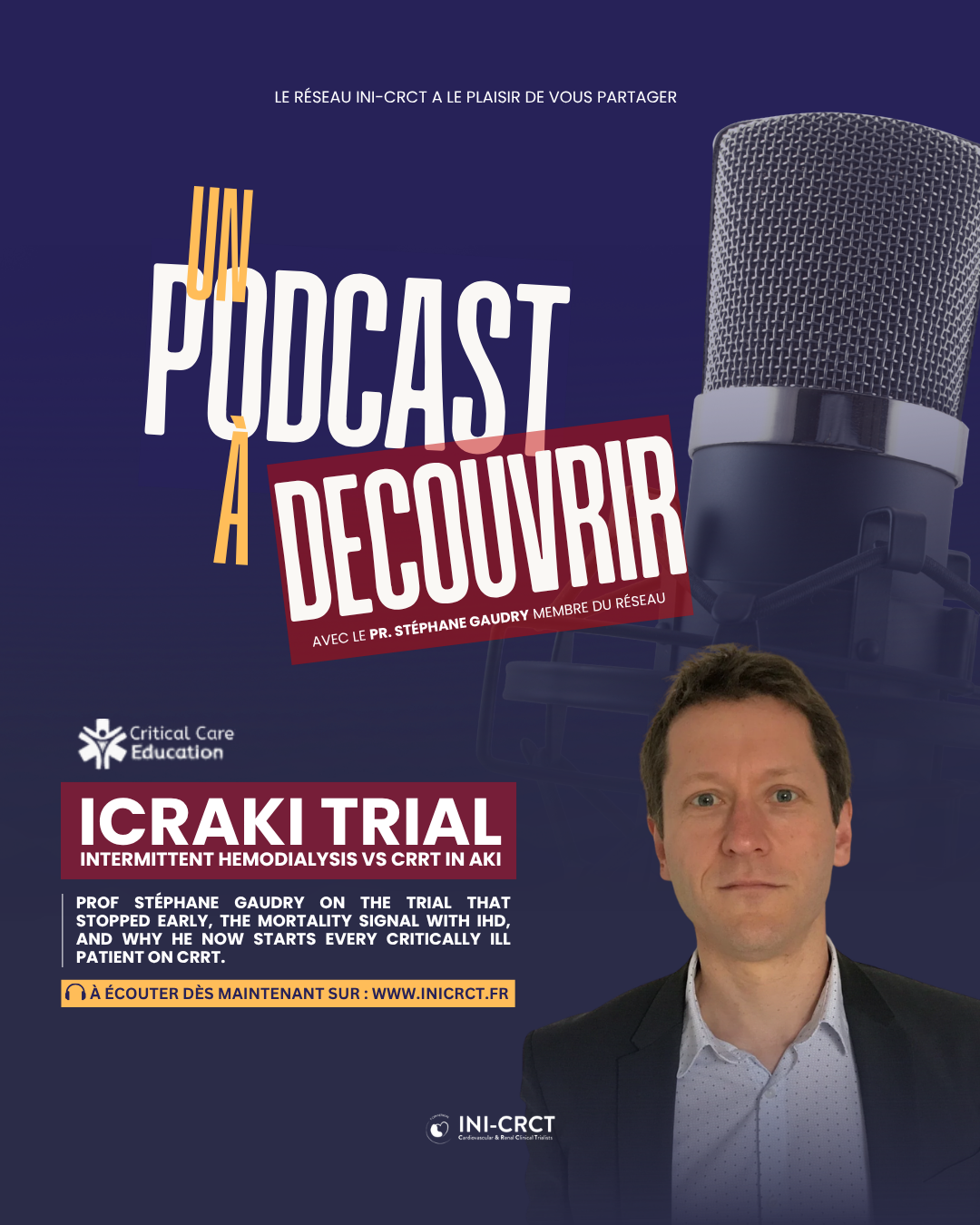

For years, the modality question in ICU renal replacement therapy felt answered. If the patient is unstable, use CRRT. If not, either will do. Professor Stéphane Gaudry never thought the evidence supported that certainty, so he tested it. The result was not what he expected.
Prof Gaudry is an intensivist, head of department at Avicenne Hospital (AP-HP) in Bobigny, Paris, and principal investigator of the AKIKI, AKIKI 2 and ICRAKI trials. In this episode of the eCritCare Podcast, he talks with Dr Swapnil Pawar about ICRAKI, recently published in the New England Journal of Medicine.
An old question in a new ICU
Every earlier randomised trial comparing intermittent hemodialysis (IHD) and CRRT, including the large HEMODIAFE trial in 2006, found no difference in survival or kidney outcomes. Yet guidance still favoured CRRT for unstable patients. Meanwhile, the patients receiving RRT had changed. Timing trials pushed practice toward deferring dialysis, so those who need it now tend to be sicker. Practice around the world varied widely, and the claim that IHD damages kidney recovery was hotly debated.
Why France had equipoise
In France, intensivists prescribe IHD themselves and adapt it for the ICU, with longer sessions and cooler dialysate to protect blood pressure. More than half of the ICRAKI investigators expected IHD to win. The design was simple: start IHD or start CRRT, keep the assigned modality to day three, and follow guidelines for the machine settings.
A non-inferiority trial with a second step
ICRAKI was built to show IHD was non-inferior, with a planned superiority test either way. The primary outcome was MAKE90: death, RRT dependence or a sustained rise in creatinine at 90 days. A win ratio analysis is still to come.
The result
The trial randomised 554 patients against a planned 1,000 before the data and safety monitoring board stopped it. MAKE90 was 78.1% with IHD and 71.6% with CRRT, so IHD was not non-inferior. Day-90 mortality was 63.1% with IHD versus 53.5% with CRRT, a hazard ratio of 1.30.
Prof Gaudry accepts that early stopping probably overstates the true difference, but every interim analysis pointed the same way. His conclusion is clear: do not use IHD as the first modality for the first three days in critically ill patients with other organ failure. The effect held regardless of vasopressor use.
Why it might happen
He offers three likely contributors. Patients on IHD needed more vasopressor support. A decade of messaging about strict fluid balance has pushed clinicians to remove more fluid, and removing two litres over a few hours is much harder on the circulation than over a full day. And while experts can run IHD beautifully, nights and weekends are covered by junior staff, where CRRT is simply easier to get right.
What changes at the bedside
His own unit now starts CRRT for the first three days, then sets a goal. If mobilisation and physiotherapy come first, they switch to intermittent therapy. If hemodynamic tolerance or fluid control is the priority, they continue CRRT. Moving to intermittent therapy after day three, where it fits, also reduces cost and environmental impact.
On SLED, his view is that it is not a separate modality, just intermittent dialysis with ICU settings. The lesson is to prescribe IHD in the ICU differently from chronic dialysis, whatever you call it.
What comes next
The next questions are which continuous technique is best, and how to stop RRT. He would like to test stopping after three days and only restarting when new criteria appear. He is sceptical that biomarkers are needed to start RRT, stop it, or diagnose AKI.
Advice for researchers
Research is 90% suffering and 10% pleasure, but the pleasure is very high. Keep it simple, chase real clinical questions rather than paper counts, and stay close to your patients and your team.
Read the full write-up with references on the website: https://critcareedu.com.au/icraki-trial-crrt-intermittent-hemodialysis/